History confirms- a massive population existed in the Prachi / Tosali / Dhauli / Bhubaneswar / Kumari Parbata valley.
History of Asoka speaks of a massacre during the great epic battle of Kalinga, in hundreds of thousands and capture in more numbers, which clearly indicates the presence of a Mahajannapada (great population) with enough Knowledge and Prosperity to attract LORD BUDHA, MAHAVIRA & thereafter Asoka in 261 BC.
And water has always held the secret to great civilizations. History of KALINGA confirm the knowledge of sophisticated and time tested water resource management system those days (2nd c B.C & beyond).
AS IN KALINGA HISTORY
Hatigumpha Cave Inscriptions
Built by Mahapadmananda 300 years before the 5th year of Kharavela's Coronation.
Renovated by Kharavela in his fifth year of Coronation.
A Jalla Pranalli or Aqua duct.
Some Historians refer to it as a place from where the water came.
Some historians refer to it as a place by the side of which the water came.
Till date not located (by history).
Hence not studied and made use of.
The word Tanusalyapatta mentioned in the Hatigumpha Inscription of King Kharavela is still in ambiguity.
Let us look at the word- TANUSALAYAPATTA- as a system to manage water– for the whole City / Kingdom. It was definitely put in place by common men not Royal people.
And in a common man�s vernacular, the breakup of the word………..
TANU �SALYA �PATTA / BATTA……Tanu in Odiya meaning as “From/ On Body. Salya means Surgical and Patta or Batta meaning Waterway”. Where body can mean body of cave, body of wall, body of mountain, body of earth itself (aqua duct).
And we clearly see the TANUSALYA PATTAs on Kumari Parbata (Khandagiri & Udayagiri hills, Bhubaneswar).
An efficient water management system has all the three aspects of…. (A) Collection and Storages,(B) Supply to points or areas for use and proper (C) Drainage of the used water.
( A ) Collection and Storage of Water
On the Khandagiri and Udayagiri Hills , King Kharavela had renovated and constructed deep cold water points in the 2nd c B.C. There are 4 Water Holes on Khandagiri and One on Udayagiri Hills. Out of the five, presently 4 of them are still functional and use. These water holes never dry up even in intense summer, where as, very interestingly borewells of Houses at the foothills dry up. The mysterious perennial stream of clear water is equated to the Ganga and we have two Water holes on Khandagiri (1) The Gupta Ganga and (2) The Akash Ganga. The other 3 are called as Kunda. A Kunda means a well defined artificially created water reservoir and we have (3) The Lalita Kunda on Udayagiri Hills, (4) The Radha Kunda and (5) The Shyama Kunda.
Besides this we also see, consealed over head water locations in the cave ceilings. Many more can be located with equipments. When such water resource management is still visible on Khandagiri and Udayagiri Hills, One can imagine the entire Kalinga Nagari. Now all those must have gone under modern urbanisation. Let us see the existing water holes excavated by King Kharavel in the 2nd c B.C.
1.The Gupta Ganga
Once upon a time only about 30 years back, water used to flow out of the cave and down the mountain side. Those days, elderly people said, on clapping before the cave entrance, water used to guss out more and more.
But now, with the passage of time and vagaries of curious tourists, the tunnel into the cave have closed its mouth and only traces of water as wet ground can be felt.
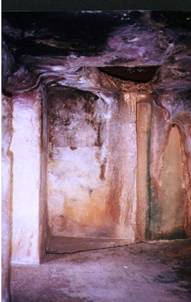
This cave fountain is situated at an elevation of 235 feet. The entrance is 7 mtrs by 4.5 mtrs and is excavated conically into the natural rock . Gives us the impression of possible inner water pools as in France.
2. The Akash Ganga
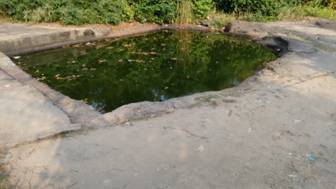
This well is situated at an elevation of 245 feet on the Khandagiri Hills. It is 7.93 mtrs by 4.73 mtrs and about 4 mtrs deep. There remains water all round the year and presently in use by Tourists, Local people and the Monks who visit this place quite often. The water looks clean in spite of direct exposure to nature.
3. The Radha Kunda
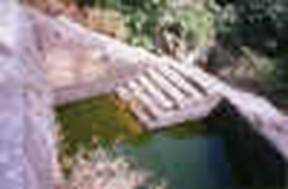
Situated at an elevation of 235 feet. This well is rectangular in shape like the others and is mostly used by Locals, Tourists and the visiting Monks due to its convenient location. It is also the largest with size of 10.06 mtrs by 4.47 mtrs and a depth of about 2 mtrs. The water is perennial, clear and threr are step cut rocks on the eastern side like in Akash Ganga. This Radha Kunda has many features to point at a Royal Bath of the Queens. Adjascent to it is also a set of large caves with open courtyard in front possibly to dry cloths and hair. This Kunda is located on Khandagiri Hill.
4. The Shyama Kunda
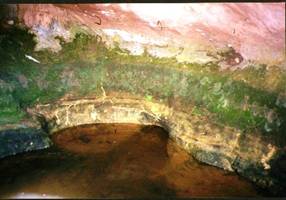
This caved water body is rarely seen due to its location at the extreme end of the Khandagiri Hill. Presently it is hidden by shrubs and wild growth. But the water is perennial and clear. Bottom of the small pool is clearly visible under water. And also can be seen some kind of connecting hole at the end of the bottom. The top and bottom of water levels can be seen from the water marks on the wall of the cave. This cave pool can be reached thru a small opening only.
5. The Lalita Kunda
The only water body on Udayagiri Hill.This is also a rectangular rock cut well with steps leading down on the eastern side. It is 10 mtrs by 5 mtrs with a depth of about 2 mtrs. Exposed to nature and the water is not clean. But used by people sparingly.Water never dries up here too.
6. The inner over head water reservoir
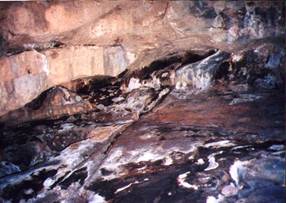
inside the ceiling of caves in Ranigumpha on Udayagiri Hill. Wet surface indicates of the presence of water even now, though due to extensive damaged condition we only see a lot of fungal growth inside. Maybe this was the special overhead water source to the kings chamber, ( Mattavarini ) near the Supitham on the left side of the first floor of Ranigumpha Cave.
7. Another large water channel
inside the Nepathyagruha of Ranigumpha on Khandagiri Hill. Water can be accessed easily in
this catchment and we also see connecting drainages to allow overflow of water. The rock cut channel as drain can be easily pluged with a block of wood and flow of water controlled.
Damaged portions of walls and ceiling exposes the inner over head water reservoir.
( B ) Supply of Water to points of use
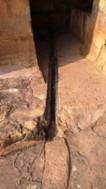
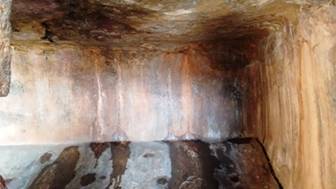
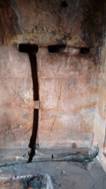
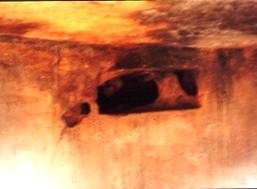
thru well designed channels. There are many water channels drilled thru rocks in caves and due to their damaged condition we are able to see some of them in important cave like the Rani Gumpha, Tatwa Gumpha etc. Even water channels have been drilled in the ceiling of caves. Some of them have been engraved upon cave walls and have been concealed thoroughly be wellcut stone slabs. We don�t know what extra adhesives were used to seal them to avoid water seepage or leakage. At important locations, well cut square holes are seen as if out flow of water was allowed with tap like control. Let us see them…
(C)The Drainages of used and rain water
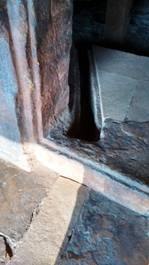
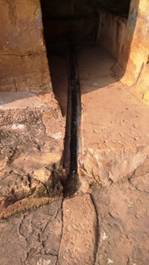
Draining of used and rain water into specific areas of the garden or forest was also very well designed. And almost all drains inside caves were covered drain. Regular geometrically straight channels on the hard rock are seem at many places on important caves. Well defined stone slabs fit exactly on the drains to cover them even from sight. It is indeed magnificent engineering of the 2nd c B.C.
There are many more such surgical incisions on cave body with appropriate gradient for smooth flow of water on both the Khandagiri and Udayagiri Hills at Bhubaneswar constructed way back in the 2nd c B.C. by the great King Maha Meghavahana Airaraja Kalinga adhipati Sree Sree Sushyamala Kharavela. More research with better equipments shall indeed bring to the fore the details of this Tannusalyapatta or Ancient Aqua Duct system of Kalinga ( Odisha ).